
Music
To ensure a smooth and successful transition from the Junior Jam scheme of work to the Kapow Primary curriculum, we will implement the designated catch-up units during the first year of teaching.
These carefully selected units are designed to bridge any gaps in knowledge, vocabulary and skills while aligning pupils’ prior musical experiences with the progression and expectations of the new scheme. By revisiting and consolidating key concepts in an engaging and supportive way, children will be able to make meaningful connections between previous learning and new musical experiences, ensuring continuity, confidence and a seamless progression in their musical development.
Intent Statement:
At Meadowhead Junior School, we believe that music is a universal language and a powerful form of expression that can inspire creativity, confidence and a lifelong appreciation of the arts. Our music curriculum aims to engage and inspire pupils to develop a love of music and their talent as musicians, increasing their self-confidence, creativity and sense of achievement.
Our music offer builds on the knowledge, skills and understanding that children have previously acquired through following the Junior Jam scheme of work over the last two years, taught by specialist music teachers. This strong foundation enables pupils to transition confidently into a more in-depth and progressive curriculum in Key Stage two.
Using the Kapow Primary Music scheme as the basis for our curriculum, we ensure children continue to progressively develop as performers, composers and listeners. The curriculum is designed to meet the requirements of the National Curriculum and provide opportunities for children to:
·Perform, listen to, review and evaluate music across a range of historical periods, genres, styles and traditions.
·Learn to sing and use their voices expressively and confidently.
·Create and compose music independently and collaboratively.
·Understand and explore how music is created, produced and communicated through the interrelated dimensions of music: pitch, duration, dynamics, tempo, timbre, texture, structure and notation.
·Develop transferable skills such as resilience, teamwork, discipline and self-expression.
We intend for all pupils to see themselves as musicians and to leave primary school with a secure understanding of musical concepts and a lifelong enjoyment of music.
Implementation Statement:
Music is taught as a discrete subject across Key Stage Two through the carefully sequenced and progressive units in the Kapow Primary scheme of work. Lessons build on prior learning from Junior Jam and revisit and deepen previously taught concepts, ensuring clear progression in both substantive knowledge and disciplinary skills.
To ensure a smooth and successful transition from the Junior Jam scheme of work to the Kapow Primary curriculum, we will implement the designated catch-up units during the first year of teaching. These carefully selected units are designed to bridge any gaps in knowledge, vocabulary and skills while aligning pupils’ prior musical experiences with the progression and expectations of the new scheme. By revisiting and consolidating key concepts in an engaging and supportive way, children will be able to make meaningful connections between previous learning and new musical experiences, ensuring continuity, confidence and a seamless progression in their musical development.
The curriculum is implemented through:
·Weekly music lessons that are practical, engaging and inclusive.
·A spiral curriculum, where key musical concepts and skills are revisited and developed over time.
·Units structured around the key strands of:
oListening and evaluating
oCreating sound
oNotation
oImprovising and composing
oPerforming
Children are given opportunities to:
·Sing regularly and develop vocal technique and confidence.
·Play tuned and untuned instruments with increasing control and expression.
·Explore rhythm, pulse and tempo through movement, body percussion and instruments.
·Compose and improvise using a range of stimuli and musical structures.
·Listen to and appraise music from different cultures, traditions and historical periods.
·Use musical vocabulary accurately when discussing, evaluating and improving their work.
·Record compositions using graphic notation and standard notation where appropriate.
Teachers are supported by clear planning, resources and CPD opportunities provided by Kapow Primary, ensuring consistency and high-quality delivery. Adaptations are made to ensure all pupils, including those with SEND and disadvantaged pupils, can fully access and succeed in music.
Additional enrichment opportunities may include:
·Choir, instrumental tuition and music clubs
·Performances in assemblies, concerts and productions
·Whole-school singing opportunities
·Celebrations of cultural and seasonal musical traditions
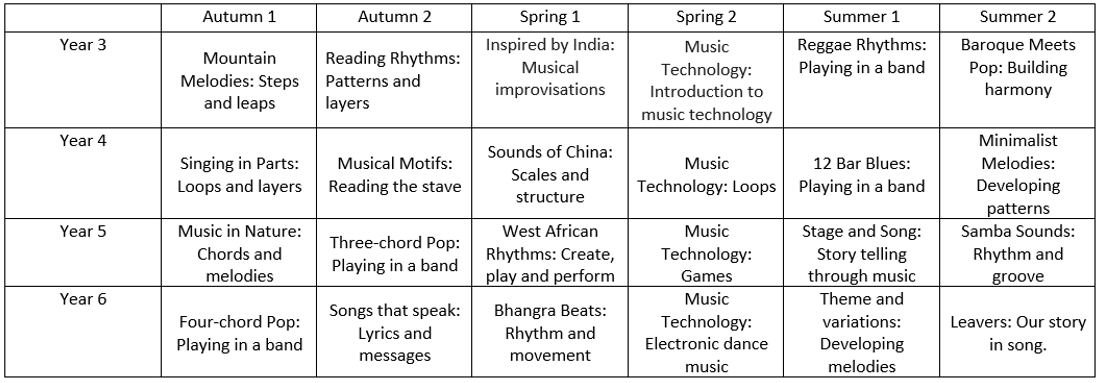
SEE THE ATTACHMENT BELOW FOR THE TRANSITION UNIT OVERVIEW THAT WILL BE FOLLOWED FROM SEPTEMBER 2026 ONWARDS.
Impact Statement
The impact of our music curriculum is that children:
·Build confidently on their prior musical experiences and demonstrate clear progression in knowledge and skills.
·Enjoy and value music and understand its importance in the wider world.
·Perform with increasing confidence, fluency, control and expression.
·Compose and improvise creatively and thoughtfully.
·Listen critically and respond using appropriate musical vocabulary.
·Appreciate and respect a diverse range of music, musicians and cultural traditions.
·Develop confidence, resilience and collaboration through shared musical experiences.
We measure the impact of our curriculum through:
·Ongoing formative assessment during lessons
·Teacher assessment against curriculum objectives
·Pupil voice and discussions about learning
·Performances and recorded outcomes
·Monitoring of planning, teaching and learning by subject leaders
·Evidence of progression over time
By the time pupils leave Key Stage Two, they will have developed a secure musical foundation and the confidence and enthusiasm to continue their musical journey into Key Stage Three and beyond.